This is Rushmore. He goes by “Rush” for short. In his little brain, getting in the car means something great is about to happen. Maybe a visit to Grandma’s, the dog park, the lake or even the vet. All great stuff if you’re a dog.
Recently, while he was in the backyard unsupervised (just for a moment), he saw a car. It had some people and other dogs in it. The back seat door was open.
Rush found a small hole in the fence that he could slip out of pretty easily. So he bolted with lightening speed out of the fence and hopped into the back seat of the car — the neighbor’s car. He sat up in the back seat (exactly like a human would sit in a car) with a look on his face that said, “OK, we can go now.”
“There’s a car with it’s door open, people, dogs… what am I waiting for?”
The difference between dogs and adult humans is that we think more. Instead of going after what we want, we ask questions like:
“What if it doesn’t work?”
“What will people think?”
“Will it be OK?”
“What if she says no?”
“Is this the right thing to do?”
What if, what if, what if…
Rush wasn’t thinking, “What if?” He just saw what he wanted and went for it. Rush can teach us adult humans a few lessons about getting what we want.
Know exactly what you want. There was no doubt in Rush’s mind that he wanted to get into that car. He had complete and total clarity about what he wanted. Successful people know exactly what they want.
Don’t worry about obstacles. Rush viewed the main barrier (the fence) not as a real barrier, but rather as a minor thing that must be overcome. He found a way to get right through it. This was not the first time he’s gotten out of a fence. Rush has six years of practice at getting out of fences. Successful people go over, under, around or through the things in their way. It gets easier with practice.
Stop caring what people think. Rush did not care if anyone thought it was inappropriate or weird to jump into a stranger’s car. He just did it. Successful people don’t care what other people think. They go after what they want without regard to other people’s opinions.
Figure out what you want and quit worrying about the obstacles and what people think. Run right out of the fence and jump in the car.
What would you do if obstacles didn’t matter and you didn’t care what people think?
This article was originally published on the Huffington Post
Janak and Nalisha Patel made some big changes in their life, and fortunately, they had their bucket list to guide them. They’ve been together since they were 17 and 20 years old. Like anyone that age, they had big dreams; they wanted to travel, have nice cars, a huge house and live by the beach. They wanted it all.
Initial “success”: They got off to a great start. Janak began a career as a mechanical engineer, and in 2004, Nalisha started a personal training business in their home country of New Zealand. In 2005, Janak was getting tired of the grind in his engineering job and quit to help Nalisha build her personal training business. At the same time, he began learning about online business.
Nalisha’s personal training business was very successful. They were making good money, had nice cars and lived by the beach. They finally had it all. They had everything they required for success.
Redefining success: When the business began to experience some issues, they saw an opportunity to take a step back and reevaluate what was important. So they asked themselves, “What does success really mean to us?”
For answers, they turned to a very logical place — their bucket list. They had created their bucket list years before and decided this was the time to dust it off and actually use it as a guide to design their life.
When they looked at the list and saw items like go to Santorini, Switzerland, Italy, Belgium and run every morning in New York’s Central Park, they knew they needed to be mobile. They couldn’t be tied down to just one place.
Now, they had a new mission for designing their life.
Making it happen: Janak and Nalisha knew what they offered in their fitness business did not have to be delivered in person. They could deliver the weight loss programs digitally via the Internet. If they didn’t have to be in any specific place to manage the business, a lot of new possibilities emerged. So they put their business completely online so it could be run with only a laptop and Internet.
In August of 2011, they put all their stuff in storage, rented out their house and booked a one-way ticket to their first destination: Miami Beach, Florida. They continued their tour for two and a half years, traveling to 45 cities in 16 countries. They recently took a brief hiatus in New Zealand, where I caught up with them for this interview, but they love their lifestyle so much that they can’t wait to get back to traveling.
Janak and Nalisha’s advice: Janak and Nalisha offered three pieces of advice for anyone who wants to pursue a new and genuine definition of success.
Decide what you want. It’s your life. Decide what will make you happy — without regard for what society calls “normal” or what others want you to do.
Put in the “big rocks” first. Figure out the big things you want to do first and make sure they get priority over the things that are less important. For Janak and Nalisha, spending their mornings together with a cup of coffee or tea is a big rock they’ve put first. Big rocks aren’t necessarily that big.
Design your business around your life. Create a business that enables you to do the things you want to do instead of doing what is important to you after work is done.
Nalisha summarizes it up best: “Get off your butt and get going!”
Jeff Steinmann Interviews Janak and Nalisha Patel on their lifestyle of travel
You can get more information about how Janak and Nalisha created their mobile lifestyle and a free ebook, 7 Steps to creating an income online so You can Escape the 9-5, at NalishaPatel.com
This article was originally published on the Huffington Post
There is a very dangerous drug on the streets that nobody is talking about. It’s called blameoin (pronounced: blame-o-win).
Blameoin is a drug that makes you believe that someone else is always at fault and there is nothing you can do about it. Blameoin users blame others for everything.
“That’s my incompetent boss’ fault!”
Blameoin allows its users to preserve their ego. Users don’t have to take responsibility for their actions. They can continue to believe they are perfect because everything is someone else’s fault.
Just like with other dangerous drugs, users feel better in the short term, but the drug slowly destroys their life. Every time they snort blameoin, they lose power to whoever or whatever they blamed. They make themselves powerless to improve the situation. If it’s your boss’ fault, what can you do about it? Your options are limited when trying to affect other people’s actions.
Your actions are the easiest ones to affect. Blameoin takes away your ability to control those actions.
“It’s the media!”
Instead of snorting blameoin, ask questions like:
Could I do my part any better next time?
What if I tried it this way instead of that way?
Is there another way to look at this that might offer different perspectives or insights?
Don’t confuse blame with fault. Taking responsibility for the things you can control does not necessarily mean you are at fault. The other person may have done something horribly wrong, unfair or even illegal, which sucks, but you can’t control that. Blaming others will always prevent you from having as much control of the situation as you potentially could. Taking responsibility for the aspects of the situation you can control does not let the wrong-doer off the hook for what they did, but it does give you the maximum possible amount of control over the situation.
“It’s because of the big corporate conglomerates!”
What if you had complete control of your life? What if you were totally in control of every aspect of your life? What if you could do exactly what you want and have everything you want, every single moment of your life?
As nice as that sounds, we will probably never have that level of control. We may not even want it. But the best way to have the greatest amount of influence on your life is to always take control of the things you can control. Taking control means never ever, ever blaming anyone else for anything.
“It’s the government!”
Look around the world. Look around and imagine that everything you want is yours for the taking if you just make the decision that you are going to do everything you can do to make your life exactly what you want it to be.
The next time something happens that you don’t like, don’t blame. Become obsessed with figuring out what you could have done to prevent it and what you can do to improve it now. Become obsessed with doing what you can do now and could do differently next time.
When trying to break an addiction to blameoin, withdrawal symptoms are normal. It means you are breaking your addiction to blameoin and on your way to getting whatever you want.
Warning: There are blameoin dealers everywhere. Unlike other drugs, blameoin is completely legal and its use is even encouraged by the highest levels of government. Nobody will ever get in trouble for selling you blameoin. Blameoin dealers are on television, on the Internet, in the newspaper, at coffee shops — even in your own home. Blameoin dealers want you to believe that someone else is controlling your life and there is nothing you can do about it; making it impossible for you to have what you want. Don’t buy it.
We humans are an ambitious bunch of people. We want to accomplish all sorts of things in our short time on earth. We want to write books, help others, learn sign language, learn musical instruments, skydive, start businesses, learn foreign languages, make a difference, break world records, ride in a hot-air balloon — the list goes on and on.
What about you? What do you want to do? At the end of your life, what would make you successful? What must you build, accomplish, change, achieve, invent, establish, develop, cultivate, cause, launch, produce, or create that will make you feel like you have been successful? It’s yours to decide. Nobody but you gets to make this decision.
Now write it down on a piece of paper.
Everyone has a different answer, but no matter what that thing is, it will require work. In fact, it will probably require a considerable amount of work. But it’s the most important thing to you, right?
Assuming you sleep for eight hours, work eight hours a day and spend at least two hours commuting, preparing for work, doing housework, laundry, cooking and all the other stuff you have to do, that only leaves about six hours each day.
According to Nielsen’s March 2014 Cross-Platform report, American adults watch an average of five hours and 15 minutes of TV each day. That eats up most of your six hours. In fact, it only leaves about 45 minutes. Granted, there’s more time on the weekends, but not much. Weekends usually contain more projects, more work, more activities and probably even more TV.
Those five hours and 15 minutes of TV each day come to 37 hours each week. Most full-time jobs are 40 hours a week. It’s almost as much time as a second full-time job. And when you include the additional three and half hours of time shifted TV (DVR) that Nielsen reports Americans watch, it’s more than a full-time job.
Is 45 minutes a day enough to get done what you must in order to be successful at the end of your life? If you are working a full-time job, have even a negligible amount normal life responsibility and watch five hours and 15 minutes of TV each day, that’s basically what you’re working with. We haven’t even included social activities. We are left to assume that social activities are relegated to Facebook at stoplights.
Now take that piece of paper on which you wrote what would make you successful and tape it to your TV screen. Put it right in the middle so it obstructs the view of the screen.
Now every time you watch TV, you have to move success out of the way.
We are at a crossroads with smartphones. We have to make an important decision. We have to decide if we’re going to let them control us or if we are going to grab them by the arm, swat them on the butt, and say, “Now listen, you’re getting too big for your britches. You are living in my pocket and I’m paying your monthly service fees, so you’re going to follow my rules. And if you don’t, you’re going to bed without a charge.”
Just like kids, smartphones need boundaries. Here are five boundaries you must put in place if you want to take back control of your smartphone.
1) Don’t let them interrupt: “Mom, mom, mom, mom, mom, mom, mom, watch me!” your smartphone says as it beeps and buzzes with text after tweet after Facebook notification.
“Honey, just a minute. The grown-ups are talking,” you say to your phone. Would you let your 4-year-old interrupt a conversation? Of course not! You’re not raising a rude child. Don’t let the silicon screamer interrupt a conversation either. Commit to finishing a conversation before checking the text. It can wait.
2) Only let them speak when spoken to: My grandpa used to say, “When I was a kid, you only spoke when spoken to.” That applies to smartphones, too. Put it on silent — all the time. What about emergencies? This is where it gets really cool. Kids aren’t allowed to call you at work any time they have a silly question or just want to say hi. They have rules they must follow. Your phone needs rules, too. There are lots of ways to silence your phone except for certain numbers like the day care, your job, spouse, elderly parents or kids. Here is how to do it for the iPhone and for Android.
3) Get a sitter: Sometimes you need to have some mommy-and-daddy (or mommy-and-mommy, or daddy-and-daddy) time. Before cell phones, when you went out to eat at a restaurant, you would leave the number of the restaurant with anyone who might need to get ahold of you in an emergency. That still works today. Leave your phone at home for at least one social event per week. Smartphones are okay to stay home by themselves, as long as they understand not to open the door for strangers.
4) Give them a bedtime: It is important that kids get adequate sleep, but another benefit of kids going to bed early is that it gives the grown-ups some time to themselves. Smartphones need a bedtime, too. Put them to bed (outside of the bedroom, in case you want to have sex) at a reasonable hour. Then they will be all charged up (pun intended… carefully planned, actually) and ready for a new day tomorrow.
5) Make them run errands: “Go give the mail to mommy,” you might say to a child. Kids love passing along messages or running small errands. Smartphones are great for that, too. Set up your phone so that you can send emails but can’t receive them (here’s how). This is wonderful. If you think of something you need to tell someone or something you can’t forget to do, just send an email or send yourself a reminder. That’s it. You’re done. No need to deal with the incoming email until it’s time to do so. Email sent and you’re back to living your life.
Technology wasn’t invented for technology’s sake. It was invented to make your life easier. It’s supposed to help you spend more time living your life and less time sustaining it. Use it that way. Time is all you have. Use technology as a tool to enjoy more of your time instead of an obligation that takes you away from living your life.
What do you really want out of life? Most of us just want to enjoy it. That means spending as much time living your life (doing all the things you love) and as little time sustaining your life (doing the boring things) as possible. I discussed the three circles in which we spend time here. The third circle we spend time in is building, which is creating things that increase the amount or quality of time we spend living in the future.
You probably have a long list of things you want to build. You may want to build a successful business, a great childhood for your kids, or a wonderful relationship with your spouse. You may want to create a better life for battered women or disadvantaged children. Whatever it is, it’s very important.
The ingredients for the things you build are resources. Wikipedia defines resources as “a source or supply from which benefit is produced.” Wikipedia goes on to say that “resources typically are materials, money, services, staff or other assets that are transformed to produce a benefit and in the process may be consumed or made unavailable.”
The resources you use to build things are your skills, money, time, or anything you might need in order to build that thing. In the process, these resources get consumed. That includes the most precious resource you have: time.
You can get more help, more ink pens, more chocolate, more friends, and more money, but you can never get more time. Time is the great equalizer. You, me, Oprah, Donald Trump, the Dahlia Lama, Abraham Lincoln, and your mom all have (or had) the same 24 hours in each day. The amount and quality of time you spend living is directly determined by how you use your 24 hours.
Every second you spend doing one thing is a second you can’t spend doing something else. Does making the bed give you a more loving relationship with your spouse? Does making the bed make your business more successful? Does making the bed help your kids become better human beings? Does making your bed improve the lives of those who you want to help? If you’re creative enough, you can say yes to any of those questions, but add to the end of the question, “more than anything else I could do right now?”
You can’t ever get more time. Spend it wisely. As you do everything you do today, ask yourself why you are doing it.
This article was originally published on the Huffington Post
We are quick to say “life is short” or “live in the moment,” but if we don’t fundamentally change the way we look at the hours in our day, it’s just talk. Here’s a way of looking at your life that puts your most precious asset, time, before anything else.
First, you have to consider where your time goes. Everything you do (besides sleeping) falls into one of three areas: sustaining, living, or building.
Sustaining is just keeping life going. Mowing the lawn, brushing your teeth, paying the bills, getting your kids ready for school in the morning, and earning money are all part of sustaining.
Living is the best things in life — the things you never want to stop doing. Maybe that’s painting, walking on the beach, working for a cause, playing with your kids, or talking about a subject you’re passionate about.
Building is creating things that increase the amount or quality of time you will spend living in the future. Building includes things like establishing relationships, creating passive income streams, writing a book, or starting a business. Too many people spend almost no time building.
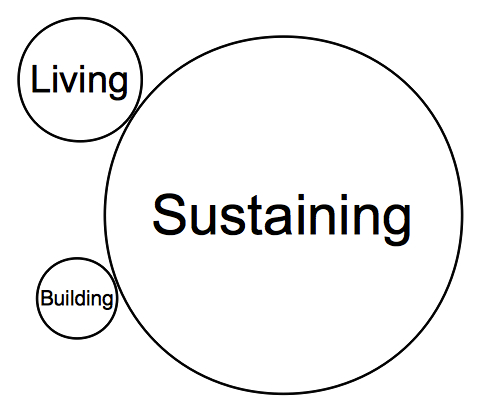
Think of each area as a circle in a Venn Diagram. The size of the circle indicates how much time you spend in that area. Usually the sustaining circle is the largest, followed by a much smaller living circle, and an even smaller building circle. These circles don’t overlap at all. This is how most people’s lives look:
The Problem The living circle is too small. It’s an afterthought. The sustaining circle is the biggest, and building barely exists. Living starts after the workday is over, only after all the sustaining is done. Living is relegated mostly to weekends and the sacred two weeks of paid vacation.
After an exhausting day that’s been eaten up by sustaining, most people can only muster a few hours of TV on the couch before falling asleep, so they can get up and do it all over again. They’re too tired to even think about building. Their circles don’t overlap. Sustaining, living, and building are completely separate. They have to stop doing one to do another.
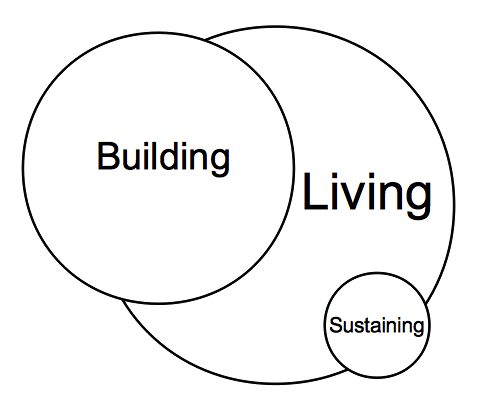
The Solution Redefine success as the amount of time you spend living. Time is finite. Once you use it, it’s gone and you can’t get more. Define success by how much time you spend doing what is important to you — inside your living circle. Your circles should look like this:
Living and building are a lot bigger, and sustaining is a lot smaller. Now, the circles overlap. Large parts of building and sustaining are inside of living. It’s not enough to just make the living circle bigger and the sustaining circle smaller. You have to bring building and sustaining inside the living circle. There are two ways to handle building and sustaining: (1) Move them inside the living circle; or (2) get other people to do them.
As I write this, I’m living. I’m sitting on my patio next to a fire on a gorgeous Saturday afternoon writing (one of my favorite things to do) about lifestyle (a topic to which I’m fiercely devoted) and this work builds my business and spreads my message. So, I’m building and living, which is my favorite place on the Venn Diagram to be! I’ve moved an activity inside the living circle!
If I had an accounting firm and was writing a newsletter to my clients, I’d hate every second of it. I don’t like accounting, and I wouldn’t be living. I’d be building but outside the living circle. That’s why I don’t have an accounting firm!
You don’t just get up one day and decide to like everything you do. Building a lifestyle takes commitment. The first step is to look at every second of your day and ask yourself in which circle it lies.
The other way to deal with activities outside your living circle is to pay someone to mow your lawn; pay someone to do the laundry; pay someone to make dinner. Pay someone to do anything you can’t get inside your living circle. You’re not going to be able to completely outsource everything outside your living circle. I don’t know how to get out of your annual dental cleaning! If you have any ideas, let me know. But make it your goal.
You might say, “But I can’t afford to pay someone to do everything I don’t want to do!” That’s OK. Most people can’t. Getting your building and sustaining circles 100 percent inside the living circle is a destination you’ll probably never reach. Your happiness in life is directly determined by how much time you spend inside your living circle. Get as close as possible, and be as happy as possible.
When opportunity comes along, ask yourself if it will allow you to spend more or less time inside your living circle. Don’t go outside your living circle any more than you have to. Every minute spent outside your living circle is a minute of your life that you’ve lost forever.
This article was originally published on the Huffington Post
Money is nothing more than a representation of value. In a previous post, we talked about how money is created by an investment of your most valuable resource.
You make money by creating value. Use your most precious asset (your time) to create value that other people want. They then give you some value (money) in return. You used your most valuable asset to create the value. They (your customer) used their most valuable asset (their time) to create value (represented by money) that they will give you in exchange for the value you created; which they want.
So, the way you get money is by creating value. Create the most valuable thing you can. It will be worth the most money. Now, since time is your most precious asset you must be sure you are enjoying what you are doing while you are creating this value! So, create that value out of something you really care about; something you like; something you love. Better yet, something you are obsessed with.
This Chihuahua is happy because she is creating value with something she cares about
I’m obsessed with finding a Better Way to Do Life because, we are nowhere near as happy as we should be as a human race. A Better Way to Do Life means a lot of things and one of the most important parts of that is changing the way we earn money.
Since time is your most precious asset; since time is what you use to create money (by creating value); you must create that value out of something you enjoy, so that you are a) living and b) creating value at the same time.
Stop thinking about Money as the goal and start thinking about Money as the result. The goal is Living your Life, and doing so in a way that creates value for other people. Then, all you do is live an awesome life that you enjoy immensely and watch the money flow in as the value is created and released into the world.
“a person who starts a business and is willing to risk loss in order to make money”
Entrepreneurship is simply identifying what value you have that other people want and delivering that value to them in exchange for other value, which we have standardized in the form of money.
Where Does Money Come From?
Money comes from time. To get money you either a) sell your time or b) create assets that make money. Option “b” ultimately generates more money from less time and it therefore is much better for lifestyle fanatics. However, it still takes time — considerable time.
You’ve got 112 hours each week. Assuming you sleep 8 hours a night, that leaves 16 each day, times 7 is 112. You probably work 40 of those hours, so that takes you right down to 72. Then there is eating, cleaning the house, driving to and from work, getting ready for work, etc, which suck up a whole lot of those 72 hours. Let’s be really conservative and say you only spend 4 hours a day on those things and we’re down to only 44 hours left.
It goes fast.
What Can You Do With Money?
You can use it to get time back. Use money to pay people to mow your lawn, do your grocery shopping, and clean your house. You use your time to make money and you use that money to get time back.
Lifestyle Fanatics are obsessed with two things:
Making money
Using that money to Build better lives for themselves and others.
Always create things that will make you money in the future, which you use, not only to make your life better, but also to make more money to make your live even better and do all the other things you want to do with money.
Why is Money Valuable?
Money is generated by investing your most valuable asset, so it therefore has considerable value itself. Further, since money allows you to make better use of your most valuable asset, it’s really awesome.
Put away your notions that money is bad, evil, or negative in any way and remember that it represents two things:
The investment of your or someone else’s most precious asset.
A tool you can use to better use your most precious asset.
To live an ultimate lifestyle of freedom you need money, but first you have to quit thinking about it in a negative way. You are giving up your most precious asset for it. Do so proudly and use that money you get in exchange to make your life everything you want it to be.-
If you asked many people if they can have whatever they want, most would say, “Of course not. There are a lot of things I want that I can’t have.”
But that’s because they are looking at it all wrong.
Then if you asked those same people why not, most would say just a few things.
“I don’t have enough money.” “I don’t have the right connections.” “I don’t know how.”
Causes Versus Results
Unfortunately, those are not causes. They are results. These are results, not the reasons why you do or do not get whatever you want.
Money, Connections, and Knowledge are results in themselves. They are very fundamental results and good ones to get because they’re resources you can use to get more of what you want.
So, you can see why getting whatever you want is so difficult when you think that results are what is stopping you from getting the results! Now let’s look at what it really takes to get those results.
How to Get Whatever You Want
Getting whatever you want requires three things.
Peace
Devotion
Choice
Peace
Start with Peace. Stop thinking that whatever you are after will make you happy. Once you have your basic needs (food, water, shelter, clothing, etc) nothing else is really going to make you happier. So, don’t look to things, like money, fame, friends, relationships and cheeseburgers to make you happier. Look instead internally for happiness. Because it’s always there. When it’s not, it’s usually because you are looking outside for it in all the wrong places. Step one to getting whatever you want is realizing that it won’t make you happier.
Devotion
Decide what you want and become Devoted to it. Care as deeply about it as you can possibly care about something. Develop such a strong Devotion to it that you cannot imagine not having it. Be sure it’s worth it. Make it something you really care about enough to Devote yourself to it. Getting whatever you want takes time. Since the hours in your day are limited (more on that here), make sure that what you want is something you would really be willing to spend the time on.
Choice
Choose to take any action necessary to get the thing you decided you want. Make a choice you can only make if you are at Peace and Devoted. Make a choice that means nothing will get in your way. You will go over, around under or through whatever obstacle stands in your way. Choose to take full responsibility for getting that thing you want.
Do it in that order. The order really matters. Peace is first because you have to be at Peace with with yourself before you can make a sound decision about what to Devote yourself to. If you aren’t at Peace, you can’t make that decision correctly; you will make an irrational decision in a futile attempt to find Peace through an external outcome. Choice is last because you must be Devoted to something before you will be motivated to fully make the Choice that is necessary to get what you want.
Getting whatever you want is not easy. But when you align these three things, it becomes possible. It doesn’t make it easier, but when you are Devoted to something, it makes the work worth it. Do not view it as an avenue to happiness. Choosing to do what you need to do to make it happen suddenly becomes completely natural. It also becomes less scary.
You can Get Whatever You Want
You can have Whatever You Want. Never believe that you cannot have Whatever You Want. If there is anything you don’t have, it’s because you Chose not to pursue it. And that’s OK because you are at Peace and made the Choice to pursue something you are Devoted to.-














 The Blog of Jeff Steinmann